
Published August 31, 2026
The ADU Play: How DC and Maryland Homeowners Are Adding Rental Income Without Moving

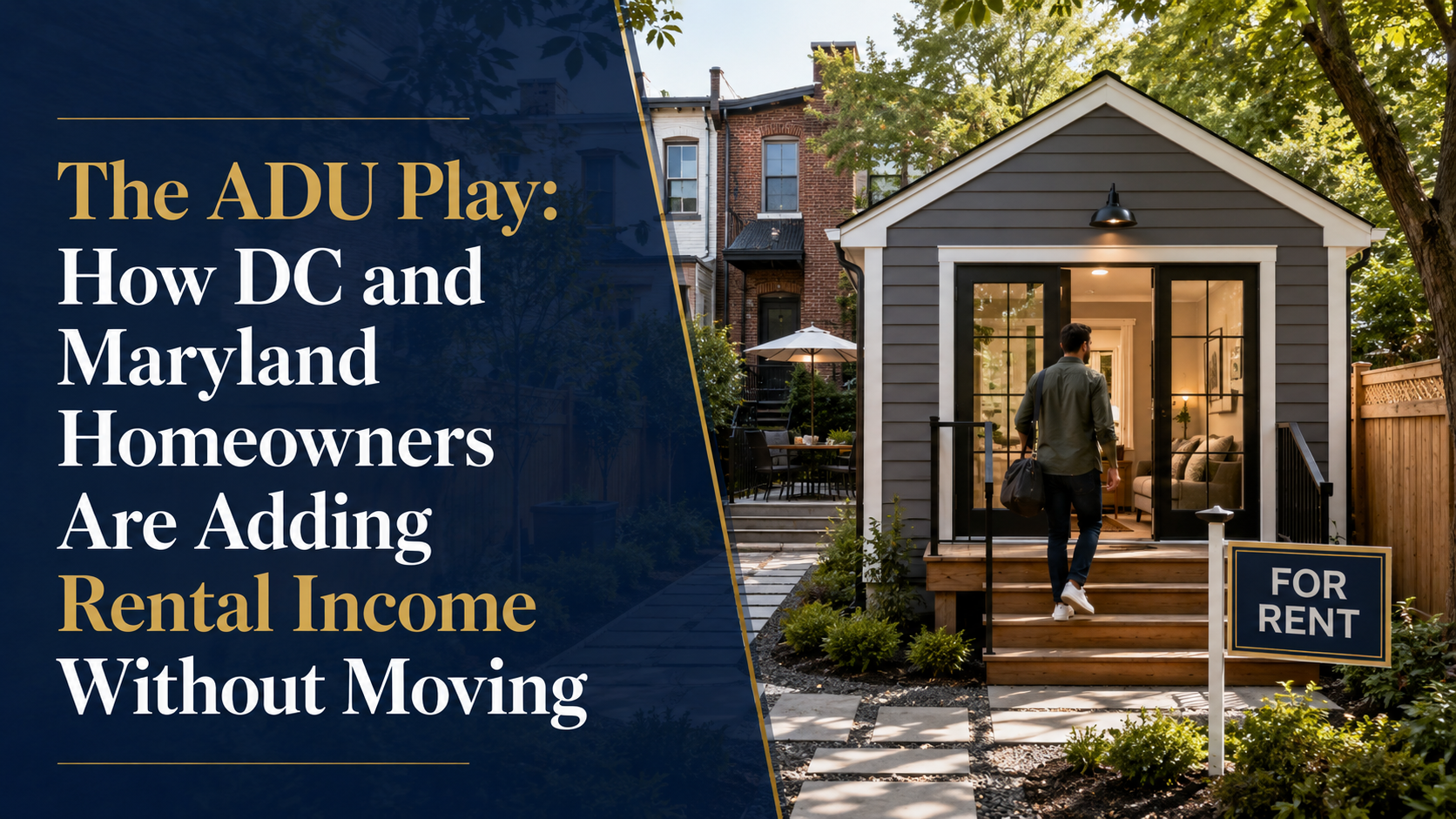
The ADU Play: How DC and Maryland Homeowners Are Adding Rental Income Without Moving

Meta description: Learn how DC and Maryland homeowners can create legal ADUs, estimate rental income, manage costs, and navigate permits without moving.
Written by Mascotti & Company, a DMV real-estate team with Keller Williams Capital Properties.
In Washington, DC, and Maryland, an accessory dwelling unit can turn unused space into a separate home: and potentially a new source of monthly income. But an ADU is not simply a finished basement or backyard cottage. As of August 2026, the rules depend on your exact jurisdiction, property type, permits, rental license, and financing plan.
Key takeaways
- Maryland law requires counties and municipalities with planning and zoning authority to adopt local ADU laws by October 1, 2026.
- Maryland’s statewide definition generally allows an ADU up to 75% of the primary detached home’s size, though local rules may add requirements.
- Howard County’s ADU rules took effect April 8, 2026, and prohibit short-term rentals in ADUs.
- DC distinguishes a market-rate accessory apartment from an income-restricted Affordable Dwelling Unit, often also abbreviated ADU.
- Regional construction estimates vary widely. A Prince George’s County planning whitepaper cites many stick-built ADU projects at $100,000 to more than $250,000, before considering the property’s specific site conditions.

Maryland and DC ADU rules: the 2026 snapshot
Maryland is moving toward a more consistent statewide framework. House Bill 1466 took effect October 1, 2025, and requires local governments to authorize ADU development on land with an existing single-family detached home by October 1, 2026.
The law defines an ADU as a secondary dwelling on the same lot as a primary single-family detached home. It may be attached to the main house or located in a separate structure. The unit can be no more than 75% of the primary home’s size under the state definition.
That does not mean every property automatically qualifies. Local governments can still regulate building safety, utilities, setbacks, parking, stormwater, historic properties, and the approval process. A county may allow an ADU by right, or it may require a conditional use or special exception.
Maryland law also limits unreasonable restrictions in deeds, HOA bylaws, and similar documents that prevent an owner from developing or offering an ADU for rent. However, local governments and HOAs may still regulate short-term rentals.
In DC, the terminology requires extra care. A market-rate basement apartment, garage conversion, or detached unit may be treated as an accessory apartment under the zoning and building rules. But DC’s official Affordable Dwelling Unit program refers to income-restricted homes with specific income, rent, and resale requirements.
The DC Department of Housing and Community Development’s ADU page explains the affordable-housing meaning of ADU. If your project is a standard market-rate accessory apartment, start with the DC Department of Buildings’ Flats and Accessory Apartments Guide.
Housing types and lifestyle fit
An ADU can take several forms. The right option depends on the home, lot, budget, and the level of separation you want between the primary residence and the rental.
Interior conversion
A basement or attic conversion is often the most practical option when lot size is limited. It may require less exterior construction, but the space still needs to meet code requirements for:
- Ceiling height
- Natural light and ventilation
- Emergency escape and rescue openings
- Fire separation
- Heating and cooling
- Plumbing and electrical systems
- A legal kitchen and bathroom
In DC, an accessory apartment must have permanent access and satisfy applicable zoning and building requirements. A finished basement is not automatically a legal rental unit.
Attached ADU
An attached unit may be created through an addition, a converted garage, or space above a garage. It can provide a separate entrance while keeping utilities and structure relatively close to the primary home.
This option may work well in parts of Montgomery County, Howard County, and other Maryland communities with larger lots. It can also be useful when a homeowner wants to preserve a backyard or avoid constructing a fully separate building.
Detached ADU
A detached backyard cottage offers the most physical separation. It may be attractive to a renter who wants a private entrance and a distinct living area. It is also usually the most complex option.
A detached unit may require new utility connections, a foundation, stormwater planning, a separate walkway, and careful placement on the lot. The Maryland Department of Planning’s ADU resource page includes an illustration of common ADU types and statewide policy resources.
Local setting matters. In DC’s established rowhouse neighborhoods, an interior conversion may be more realistic than a detached cottage. In suburban Maryland, a garage conversion or detached unit may have more potential, but lot coverage and drainage can become major constraints.
Budgeting for an ADU project
The rental income is only one side of the calculation. Before moving forward, build a complete project budget.
A Prince George’s County Planning Department whitepaper published in 2024 cites a broad range of $100,000 to more than $250,000 for many stick-built ADU projects. It also notes that costs vary based on the unit’s size, quality, site conditions, utilities, and design.
Your budget may include:
- Architectural plans and engineering
- Zoning review and building permits
- Electrical, plumbing, and mechanical work
- Foundation or structural repairs
- Sewer, water, and utility upgrades
- Fire sprinklers or fire-rated assemblies
- Egress windows and exterior stairs
- Insulation and energy-code improvements
- Stormwater management
- Rental licensing and inspections
- Construction financing interest
- Insurance and ongoing maintenance

Do not use gross rent as your projected return. A better calculation is:
Expected rent – vacancy – maintenance – utilities paid by owner – insurance – property taxes – management – financing costs = estimated net income
For example, a unit that rents for $2,000 per month produces $24,000 in gross annual rent. That does not mean the project pays for itself quickly. A $200,000 construction project would have a simple gross-rent payback period of more than eight years before operating costs, taxes, financing, and vacancy.
Your lender may also have specific rules about rental income from an ADU. Ask whether the projected rent can be used to qualify for financing and what documentation is required. A real-estate attorney and tax professional can help you understand depreciation, insurance, lease requirements, and reporting obligations.
Important DC distinction
If the unit is part of DC’s income-restricted ADU or Inclusionary Zoning program, rent may be capped. DHCD’s 2026 maximum income, rent, and purchase price schedule lists different limits based on household size, unit size, and income level.
A market-rate accessory apartment is a different category. Confirm the legal classification before projecting rent.
A practical strategy for homeowners
The strongest ADU projects usually begin with a property and financial review: not with a contractor’s rendering.
1. Confirm eligibility before paying for full plans
Check the zoning district, property records, lot dimensions, existing permits, HOA documents, historic-designation status, and utility capacity. Ask the local planning department whether the project is permitted by right or requires additional approval.
Howard County provides an ADU overview and interactive map, but the county warns that a property shown as having potential on the map is not guaranteed to qualify.
2. Decide whether long-term rent is your actual plan
Many DMV jurisdictions restrict or prohibit short-term rentals in ADUs. Howard County states that ADUs may not be used as short-term rentals. Prince George’s County’s planning materials state that ADUs may not be rented for terms of less than 30 days.
Plan around a conventional long-term lease unless your local government and HOA clearly allow another arrangement.
3. Design for durability, not just appearance
A durable ADU needs sound insulation, separate access, practical storage, efficient heating and cooling, and easy-to-maintain finishes. These details can help reduce turnover and ongoing repair costs.
A flexible layout may also allow the unit to serve another purpose later, such as a private office, guest space, or accessible living area.
4. Know when to walk away
An ADU may not make financial sense if:
- The project requires major foundation or sewer work.
- The unit cannot have legal egress.
- Construction costs exceed the likely rent-supported value.
- The property cannot meet parking, setback, or stormwater rules.
- Financing depends on rent that a lender will not recognize.
- You are relying on short-term rental income that local rules prohibit.

Local proof points across the DMV
- Washington, DC: Accessory apartments are closely tied to zoning, building permits, and rental licensing. DC’s affordable ADU program has separate income and rent restrictions.
- Howard County: Council Bill 3-2026 became effective April 8, 2026. The county allows attached and detached ADUs in various residential districts, requires owner occupancy, and prohibits short-term rentals.
- Prince George’s County: The county’s ADU whitepaper highlights basement, garage, attached, and detached configurations. Its materials also emphasize site constraints, fire-suppression requirements, setbacks, and long-term occupancy rules.
The best next step is to evaluate the specific property: not simply the county where it is located.
Frequently asked questions
Can I rent out an ADU in Maryland?
Generally, Maryland’s statewide framework supports long-term ADU rentals on qualifying properties. You still need to follow local zoning, building, licensing, inspection, HOA, and landlord-tenant rules.
Does an ADU have to be detached from the main house?
No. An ADU may be inside the primary home, attached as an addition, located above a garage, created through a garage conversion, or built as a detached structure.
Can I use a DC basement as a rental apartment?
Possibly, but a finished basement is not automatically a legal rental. You may need zoning confirmation, building and trade permits, inspections, a residential rental license, and compliance with habitability requirements.
Are short-term rentals allowed in Maryland ADUs?
Not always. Many local jurisdictions restrict them. Howard County prohibits short-term rentals in ADUs, and Prince George’s County materials prohibit leases of fewer than 30 days. Confirm the current rule for your property.
Will an ADU increase my home’s value?
It may, but the effect depends on legal status, design, location, market demand, construction quality, and operating costs. Do not assume every dollar spent will return dollar-for-dollar at resale.
Thinking about buying a home with ADU potential?
Browse DMV listings and look for properties with finished basements, detached garages, larger lots, or flexible floor plans. Then connect with Mascotti & Company for a property-specific conversation about zoning questions, resale considerations, and a realistic rental-income analysis.
This article is for general educational purposes and is not legal, tax, zoning, construction, or financial advice. Regulations and program requirements can change. Confirm current requirements with the applicable local government, lender, licensed contractor, attorney, and tax professional.
Mascotti & Company provides equal professional services without regard to race, color, religion, sex (including gender identity and sexual orientation), disability, familial status, or national origin.